

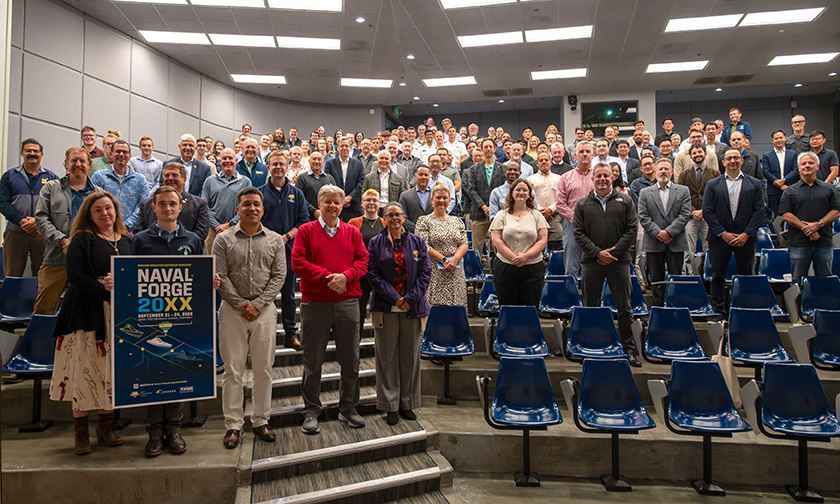
The Naval Postgraduate School (NPS) recently conducted its annual Warfare Innovation Continuum (WIC) Workshop. The four-day event was held by the NPS Office of Warfare Studies (OWS), Sept. 21-24.
Themed “Naval Forge 20XX,” the workshop brought together 228 students and representatives of industry, civilian academia, the fleet, systems commands, as well as international participants from Singapore, Brazil, Japan, India and the United Kingdom to test innovative solutions to some of the most complex challenges facing the naval force of today and tomorrow.
“The WIC Workshop is a free and open space for deep exploration of this complex military challenge,” said Lyla Englehorn, OWS Concepts Branch Lead. “Students’ work could potentially have significant impact and influence for naval leadership and shape the direction of NPS future research.”
The theme of the workshop stems directly from Chief of Naval Operations (CNO) Adm. Daryl Caudle’s Fighting Instructions in which he lays out the need for a new strategy — termed the Hedge Strategy — to guide U.S. Navy forces.
A force-planning and operational framework, the Hedge Strategy balances expensive, high-end multi-mission warships with scalable, cost-effective autonomous systems and modular force packages to manage global great-power risks within tight budgets and industrial limits.
“What we're seeing is the undeniable dawn of the robotics age of warfare,” said retired U.S. Navy Capt. Jeff Kline, professor emeritus of operations research and founder of the WIC program. “Today, autonomous robotic systems are augmenting precision missiles, and in some cases, bypassing them.”

This fundamental premise was further refined into the overarching design challenge of the workshop: “How might advanced manufacturing and emerging technologies in shipbuilding, sustainment and repair as a "Naval Forge" of the future enable warfighting concepts and enhance all-domain force design?”
To set the context and convey a sense of urgency, the NPS Writers Room and 2026 Ford Fellows crafted a fictional scenario envisioning what the world might look like as an international conflict emerges in the future. Entitled “Warscrolling 20XX,” a play on the term “doomscrolling,” the featurette paints a challenging global portrait through social media-style video clips featuring cameos by NPS faculty, students and staff.
The scenario informed the formation of ten rapid concept generation teams, each examining a different aspect of the design challenge. These teams drew from the unique perspectives of their members — from NPS students and experienced operators to early-career engineers and researchers — all focused on innovative approaches to specific aspects of the Hedge Strategy.
Specifically, they explored all domain operations, casualty evacuation (CASEVAC), deterrence and sustainment, directed energy, operational and installation energy, Maritime Operations Center (MOC) operations, seabed infrastructure and operations, targeting and fires, robotics and autonomous systems (RAS) development priorities, and RAS support of future mission areas.
Of these, three teams worked at the classified level, three included international participants, and three worked on sponsored research.

After more than 12 hours of breakout sessions spread over three and a half days — and a seemingly endless supply of sticky notes — the teams engaged in a rapid generation process using warfighter-centered design tools, arriving at novel approaches to the design challenge. Each team presented its best concepts on the final morning of the workshop.
The teams generated concepts across logistics, casualty care, energy, autonomous systems, decision support and undersea warfare, including:
Partially Autonomous Resource Recovery Organizing Tool (PARROT)
- A logistics and tasking master-planning tool conceived by the all-domain operations team for use in a dynamic operational environment.
Continuum of Care
- The CASEVAC team developed a Continuum of Care concept, including a Spider platform and Lilypad drone, to ensure successful CASEVAC from point of injury to rehabilitative care.
Tactical Underwater Remote Transport Logistics Equipment (TURTLE) Fleet
- The concept of small, attritable, self-powered, autonomous semi-submersibles used for hard-to-detect subsurface swarm transport and distributed delivery was put forth by the deterrence and sustainment team.
Cognitive High-Powered Microwave (HPM)
- A cognitive HPM, as conceived by the directed energy team, would defend Expeditionary Advanced Bases and utilized for space domain missions.
MOC the Boat
- MOC Operations envisioned “MOC the Boat,” using human-SI teaming to support a continuous planning loop via SI support agents for the human decision chain.
Energy Positioned at the Point of Need
- The operational energy team drew up the concept of distributed energy generation and storage combined with distribution and energy conversion stations that provide energy to fuel-flexible users.
Project Autonomous Robotic Continuum (ARC)
- A RAS roadmap for the U.S. Marine Corps developed by the RAS roadmap team to develop, acquire, field and operate future RAS.
Subsea and Seabed Warfare Development Center (SSWDC)
- This center, developed by the seabed infrastructure and operations team, would focus on research and development of biomimetic systems to work in tandem with future autonomous and crewed systems.
Task Force Critical Undersea Infrastructure (TF CUI)
- A TF CUI, as envisioned by the seabed RAS team, would use distributed sensors and cognitive SI to enable integrated subsea and surface domain awareness.
Targeting Marketplace
- A platform developed by the targeting team would allow effectors to autonomously bid on assigned targets and communicate needs to government and industry stakeholders.
Together, they forge the particulars of a possible future fleet, one in which the Hedge Strategy enables and ensures homeland defense, global deterrence and national prosperity.
The warfighting concepts generated at the WIC Workshop do not stop here, however. In addition to being vetted and disseminated across Navy leadership, including OPNAV sections, the Marine Corps Warfighting Lab (MCWL) and Naval Surface Warfare Centers (NSWC), they will serve as the cornerstone of the fiscal year (FY) 2027 WIC cycle.
Over the next year the “Forge 20XX” theme — and its scenario, design challenge and concept generation — will be carried over to synergize classes, research and programmatic threads across campus.
It will inspire individual theses and class projects. It will be woven into seven different courses, including Wargaming and Joint Campaign Analysis. Related emerging technology solutions will be further evaluated through multiple quarterly Joint Interagency Field Experimentation (JIFX) events. It will form the basis of several Consortium for Robotics and Unmanned Systems Education and Research (CRUSER) innovation and research projects. It will serve as the capstone project for the Temasek Defence Systems Institute (TDSI) Systems Engineering Analysis (SEA) cohort, a partnership between NPS and the National University of Singapore. And much more.
But the WIC Workshop’s greatest value, leaders stress, lies in its investment in NPS’ warrior-scholar students, who bring this experience forward throughout their NPS studies and beyond as they return to the fleet and force.
Deep immersion into the WIC’s problem sets, and contacts made across the naval enterprise — from industry, systems commands and warfare development commands — means long-term engagement with the issues long after they’ve left NPS.
“The most effective WIC product we obtain is to have our junior officers think hard and learn about the complex problems they’re going to face in their careers and to explore possible solutions,” Kline said.