Innovation at the Naval Postgraduate School (NPS) does not end when a research project is completed or a patent is awarded. Transforming an idea from a creative spark in the lab into a game-changing capability in the hands of a warfighter requires a seamless transition between academia, military and industry.
NPS excels at this.
Through its Emerging Technology and Innovation Office (ETIO), part of the Office of Research and Innovation (ORI), NPS serves as a bridge between government research and private sector innovation, helping identify pathways for technologies developed by faculty and students to mature into products and services with military and commercial value.
By working closely with the institution’s Partnership Intermediary Agreement (PIA) organizations — including Fleetwerx, the Naval Postgraduate School Foundation and TechLink —NPS connects researchers with entrepreneurs, investors and companies interested in developing new capabilities.
This technology transfer is a critical component of the Department of the Navy innovation ecosystem. It enables federal laboratories and research institutions to collaborate with industry through agreements that allow for the exchange of expertise, testing opportunities and intellectual property.
"We engage with non-federal entities to promote technologies that have been developed at our labs,” said Agata Maslowska, NPS technology transfer lead. “The goal is to improve technologies that we developed, or evaluate commercial technologies that already exist, and determine how they can be scaled to meet military needs.”
ETIO facilitates several mechanisms that help bridge the gap between research and operational application. While Cooperative Research and Development Agreements, or CRADAs, provide a framework for the execution of research between NPS and non-federal entities, the institution has developed critical mechanisms with its PIA partners to ensure key innovations don’t just stay in the lab.
“Part of the question is, how do we actually get technology into the hands of the warfighter?” said Kaitie Penry, Director of Emerging Technology and Innovation within ORI. “There are several different pathways, and technology transfer helps enable that transition.”
One pathway involves licensing NPS-developed intellectual property to companies that can further develop, manufacture and ultimately deliver products back to government customers. In addition, with the help of its PIA partners, ETIO facilitates more direct engagement with potential partners who can help mature research into market-ready solutions.
To support that effort, NPS launched a series of “From Lab to Launch” Reverse Pitch events, the next of which is BlueTech Nexus, slated for Sept. 22 at Hopkins Marine Station in Monterey.
This reverse pitch event will convene strategic investors, maritime technology companies, defense integrators and Navy stakeholders to preview a select portfolio of NPS patented technologies available for licensing, with a focus on autonomy, AI, sensing and maritime systems.

BlueTech Nexus will also feature a new collaboration with California State University Monterey Bay (CSUMB). Students in a business-oriented commercialization course are helping transform technical research into market-focused presentations designed to resonate with investors and technology companies.
Unlike traditional pitch events where startups seek investment, NPS researchers present technologies directly to industry representatives, venture capital firms and prospective commercialization partners at these “From Lab to Launch” events.
And these efforts have proven successful. NPS’ first reverse pitch event back in 2025 resulted in one of the largest licensing returns in school history, demonstrating the value of connecting innovators directly with the commercial marketplace.
“The highlight was a piece of technology where the co-inventor was a student,” Penry said. “It really shows why NPS can make a difference when you have the warfighter in the room doing the research and developing the technology.”
That combination of student operational experience and faculty defense expertise remains one of NPS’ greatest strengths. Military students arrive on campus directly from operational assignments and bring firsthand knowledge of challenges confronting the fleet and joint force. Working alongside faculty researchers, they help develop practical solutions shaped by real-world requirements.
“Our students come from the fleet,” Maslowska said. “They know what is needed to improve operations, and their input is incredibly valuable.”
Many NPS inventions include student co-inventors, underscoring the institution's unique role in combining education, research and operational relevance.
“It reinforces the credibility of the research and education conducted here at NPS,” Penry said. “The more our technologies are wanted out in the community, the more it shows that what we are doing here has an impact on national security.”
One of the most significant recent opportunities for expanding technology transition has been the U.S. Department of War’s Defense Patent Holiday initiative. The program allows companies to obtain Commercial Evaluation Licenses (CELs) for no fee, giving them an opportunity to evaluate patented government technologies before committing to full licensing agreements.
The initiative lowers barriers for industry to explore federal innovations while creating new pathways for technology transition, commercialization and eventual fielding.
To date, 25 Defense Patent Holiday CELs have been executed across the military services, and 14 of them are from Navy organizations. Of those, impressively, 10 originate from NPS technologies.
Those licenses represent companies across the defense, aerospace, space systems, communications, advanced technology and energy sectors.
While some defense laboratories have participated selectively, NPS embraced the initiative as an opportunity to increase visibility for its research portfolio and accelerate transition opportunities.
“It’s a lot of work, but it’s worth the investment,” Maslowska said. “We’ve already seen tremendous interest in our technologies.”
That interest is reflected in the technologies attracting the greatest commercial attention.
The clear leader is NPS’ Mixed Reality technology portfolio, which has generated four executed CELs and another currently in process. Originally developed to support training and quality assurance applications, the technology is drawing interest for defense readiness, aviation flight training, workflow guidance, logistics operations, manufacturing training and human-machine teaming applications.

“What is fascinating is how many different applications companies see in the same technology,” Maslowska said. “There are so many different ways they want to utilize it.”
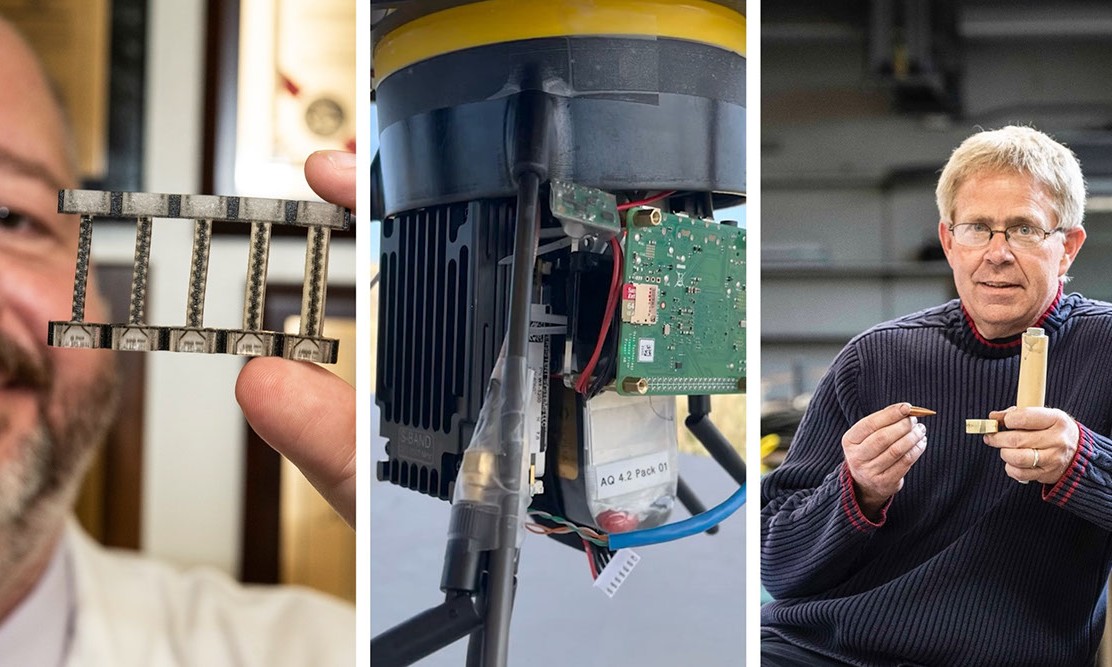
The second most sought-after technology is NPS’ Phase Change Composite thermal management technology, which currently has two executed CELs and two more pending. Potential applications include spacecraft thermal management, thermal energy storage, expeditionary power systems, off-grid energy generation, disaster response support and infrastructure temperature regulation.
Another emerging technology attracting significant attention is the Extended Semi-Supervised Learning (SSL) Network, an artificial intelligence and machine learning capability developed at NPS. The technology has already generated one executed CEL and two additional licenses in process. Companies are exploring applications ranging from hyperspectral imagery analysis and automatic target recognition to anomaly detection, healthcare analytics, energy exploration and mining operations.
Taken together, current licensing activity indicates concentrated demand in four major areas: immersive training and mixed reality, thermal management and energy storage, artificial intelligence for sensing and analytics, and space and remote-sensing technologies.
The growing interest demonstrates the broader relevance of research conducted at NPS, where technologies designed to solve military challenges often possess significant commercial potential as well.
“NPS and other DON laboratories are vital for fostering innovation that can develop capabilities for military needs,” said Dr. Maddie Mettler, technology manager with TechLink. “To move those innovations to market, we need to bring industry partners to the table.”
“The tech transfer ecosystem empowers industry partners to harness the research investment DON labs like NPS have made to increase the speed at which technology can be delivered to the warfighter and adapted for civilian use,” she continued. “Events like BlueTech Nexus and new initiatives such as the Defense Patent Holiday are bringing technology transfer to the forefront in the DON.”
As NPS’ ETIO continues to create opportunities for the rapid transition of NPS-developed technologies, such as the upcoming BlueTech Nexus, the institution is expanding the network needed to transition promising technologies beyond the research stage.
“The opportunity right now is to make those technologies matter,” Maslowska said. “To make them into something that both the U.S. economy and the warfighter can benefit from.”
By connecting military operators, faculty researchers, industry partners and investors, NPS is helping accelerate the innovation process and shorten the distance between discovery and deployment.
In doing so, the university is demonstrating that the true measure of innovation is not simply a patent on the wall, but a capability delivered to those who need it most.