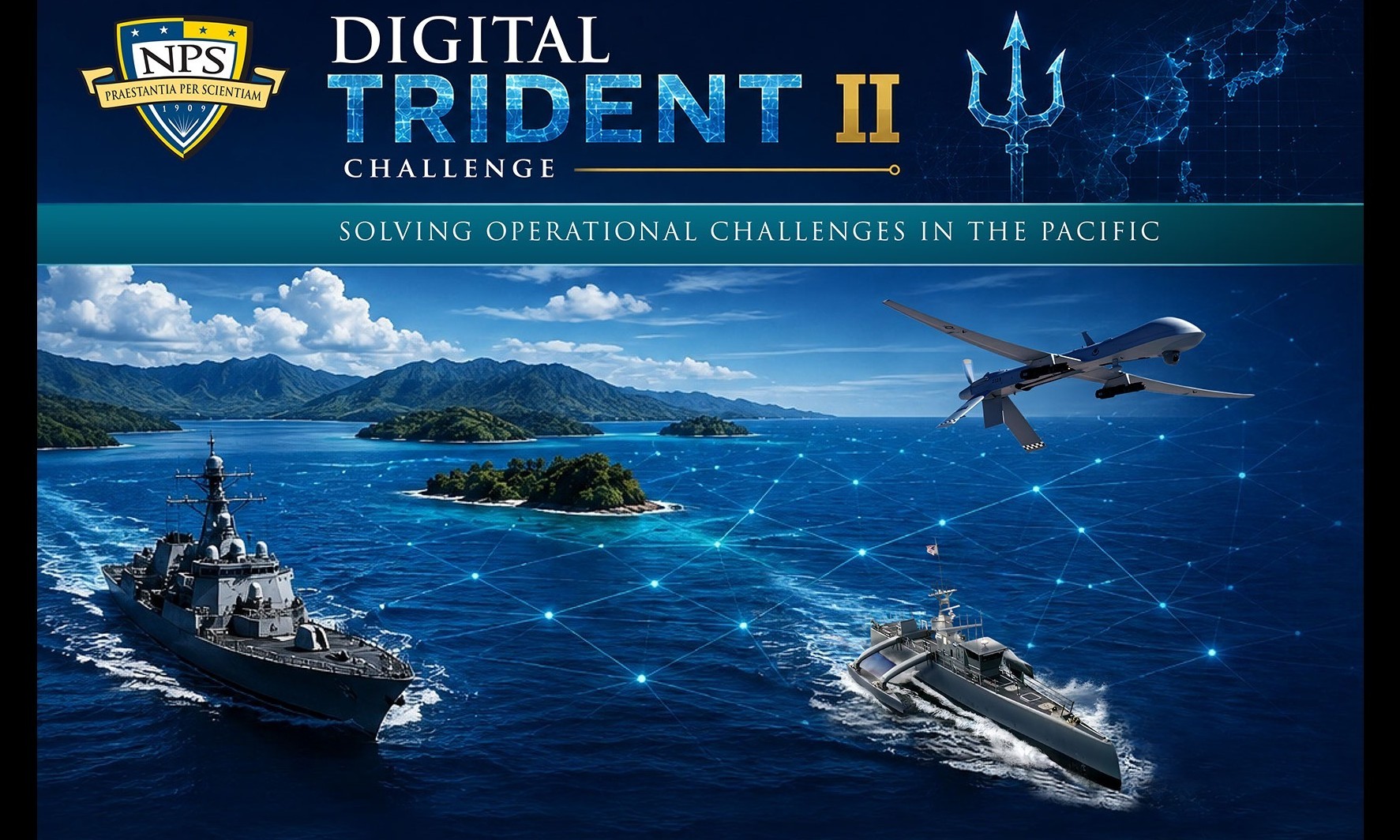
The Naval Postgraduate School Office of Research and Innovation announced nine projects selected for development through the Digital Trident II initiative. Chosen through a competitive process, the projects bring NPS researchers, operational stakeholders and partners together to address consequential challenges facing U.S. forces in the Pacific.
Digital Trident II is an NPS research and development initiative that connects operational challenges in the Pacific with interdisciplinary faculty and student expertise, emerging technologies, and external partners. Through a competitive selection process, the initiative provides promising projects with resources and stakeholder access to refine concepts, conduct experimentation, assess operational relevance, and pursue pathways toward further development or use.
“At NPS, we have a unique ability to bring together warfighters, researchers, and technologists to work on problems that matter,” added Kaitie Penry, NPS Director of Emerging Technology and Innovation, and Digital Trident program lead. “Digital Trident applies that strength directly to Pacific Theater challenges by connecting operational needs with emerging technologies and giving promising ideas a path from concept to real-world impact.”
Together, the nine selected projects address three connected operational requirements: improving awareness and decision-making, developing and employing autonomous capabilities, and strengthening readiness, sustainment, and operational planning across the Pacific. The projects are grouped below according to their principal contribution, although several span more than one area.
Awareness, Information and Decision Support
SPECTRAL: Space domain awareness for Passive Emissions Control/Concealment and Tactical Radio Agentic Logic
Will develop a super intelligence (SI)-enabled, edge-based space domain awareness capability to help tactical units identify safe communication and maneuver windows while minimizing detection by adversary space-based sensors.
Project ARSENAL (Adaptive Response System for information Effects, Network Attack, and Lethality)
Will integrate five emerging capabilities into a modular toolkit designed to enhance U.S. Pacific Command information warfare decision-making and operational advantage.
Space-Based Neuromorphic Sensors for Tip-and-Cue Operations
Will develop SI/ML-enabled processing for event-based sensors operating in space with the goal to improve maritime and space domain awareness and operational responsiveness in the Pacific.
Project Adversarial Agents
Will develop a multi-agent SI framework to enhance wargaming and tabletop exercises that accelerate adversarial analysis, improve decision-making, and strengthen Pacific-focused planning and partner interoperability.
Autonomous Capabilities, Fires and Mission Planning
Applied SI for Autonomous Interceptor Development
Will advance a flight-ready prototype of an affordable interceptor designed to counter unmanned aircraft, in support of a direct transition to Marine Corps operational development.
Rapid Modeling and Simulation and Human-SI Teaming for Accelerated Joint Fires Planning for Warfighters
Will adapt an SI-enabled platform to help warfighters rapidly develop, test, and refine joint fires plans to accelerate decision-making, optimize synchronization, and improve operational planning.
Agentic Mission Planner to Enable Long-Endurance UAV Operations at Scale
Will automate mission planning, leverages advanced machine learning weather prediction to optimize flight routes and endurance, and transform massive volumes of UAV telemetry to increase operational reach, reduce planning and analysis burdens, and enhance decision support for persistent operations across U.S. Pacific Command.
Readiness, Logistics and Sustainment
MCOO-X: SI-Enabled Decision Support for Unmanned Systems Logistics
Will develop the allocation, positioning, and sustainment of unmanned systems across the Pacific, helping U.S. Pacific Command and Special Operations Command Pacific (SOCPAC) planners identify capability gaps, assess risk, and improve resilience under contested operational conditions.
ANVIL
Will automate readiness analysis and talent management by integrating personnel, training, readiness, and logistics data into an AI-powered decision support tool to help commanders make faster, more informed decisions.
The selected teams will now work with operational stakeholders and technical partners to refine requirements, test assumptions and assess progress against defined development milestones. Evidence and user feedback generated through that process will inform decisions about follow-on research, additional experimentation and potential pathways toward application or transition. The Digital Trident II initiative is managed by the NPS Office of Research and Innovation in collaboration with the NPS Foundation under its Partnership Intermediary Agreement with NPS.